Neighborhood Guide
Falling Water
An unincorporated community in the ridges and hollows north of Chattanooga where a 110-foot waterfall gives the area its name. About 1,900 people live across five square miles of wooded terrain between Signal Mountain and Hixson, with quick access to both the Cumberland Plateau trail system and downtown.
About Falling Water
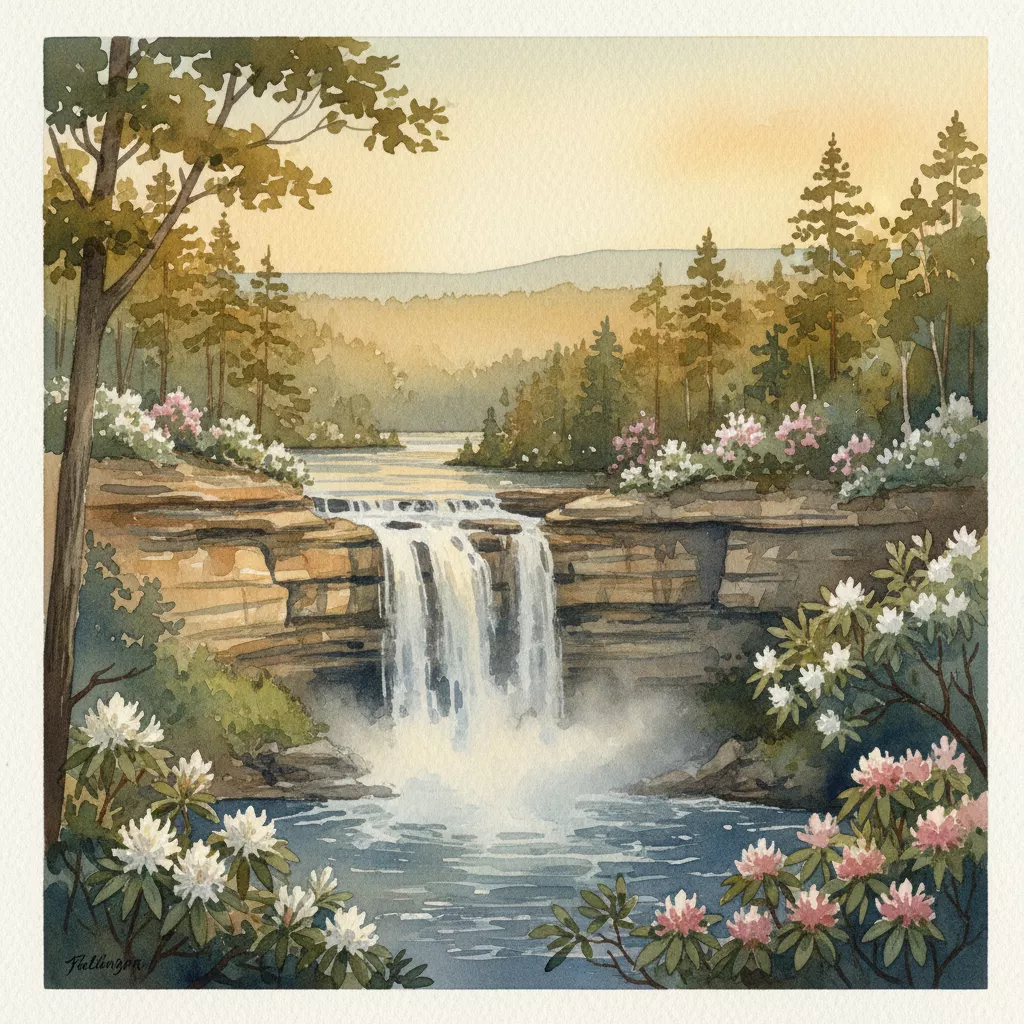
Falling Water sits in the ridges and hollows where the Cumberland Plateau drops toward the Tennessee Valley, roughly 10 miles north of downtown Chattanooga. The community takes its name from the most obvious feature of the landscape - Little Falling Water Creek, which pours 110 feet over a sandstone ledge into a narrow gorge before winding its way down to meet Big Falling Water Creek in Pickett Gulf. That waterfall has been drawing people to this stretch of Hamilton County for generations, and the community that grew up around it has kept a distinctly rural feel even as Chattanooga expanded outward.
Unlike many of the communities we cover, Falling Water never incorporated as a city or town. It remains an unincorporated census-designated place within Hamilton County, governed by the county commission rather than its own municipal government. That status means no city taxes but also no local police force or independent zoning authority. For the roughly 1,900 residents who live here, that trade-off seems to work just fine.
The Geography That Shapes Everything
Falling Water covers about 5 square miles of terrain that would be generous to call flat. The community occupies the transitional zone between the valley floor and the plateau above, which means steep hollows, wooded ridgelines, and the kind of winding roads where you shift your perspective every quarter mile. State Route 153 and U.S. Route 27 border the area, with Route 27 running north to south through the southern portion, giving residents a straight shot to Hixson's shopping and restaurants or downtown Chattanooga in about 15 minutes.
The elevation change is what makes the place special. In the span of a short drive you can go from the valley near Hixson up into the forested ridges where the plateau begins to assert itself. That gradient creates microclimates - cooler air in the hollows, warmer sun on the ridgetops, and fog that rolls through the creek bottoms on fall mornings in a way that makes the whole community feel tucked away from the rest of the metro area.
Falling Water Falls
The namesake waterfall is the community's most recognized feature and one of the Chattanooga area's best-kept hiking secrets. Little Falling Water Creek drops 110 feet over resistant sandstone at the edge of the Cumberland Plateau, plunging into Falling Water Gorge below. The Tennessee Department of Environment and Conservation designated the surrounding 136 acres as a State Natural Area, protecting a second-growth hardwood forest of oak-hickory and mixed mesophytic communities with mountain laurel, rosebay rhododendron, and eastern hemlock throughout.
The trail to the falls is short, but the scenery punches well above its distance. From the top you get a vista of the Tennessee River Valley, Pickett Gulf, and Buzzard Point that stretches for miles. The gorge itself stays lush and green most of the year, with moss-covered boulders and the constant sound of moving water. The area is also home to a small population of the federally endangered large-flowered skullcap, making it ecologically significant beyond just the scenery.
A word of practical advice: the parking area on Falling Water Trail holds only three vehicles, and cars parked along the street in the Forest Park neighborhood get towed. Arrive early on weekends or you will be walking a lot farther.
A Community Built in the Ridges
Construction in Falling Water dates back to the early 1900s, with homes scattered along the ridgelines and tucked into the hollows. The community grew slowly compared to places like Hixson to the south, mostly because the terrain made large-scale subdivision development impractical. You can build a house on a ridge, but you cannot easily flatten it into cul-de-sacs.
That physical constraint turned out to be a feature rather than a bug. Falling Water developed as a collection of neat subdivisions and winding backroads rather than the sprawling tract housing that characterizes much of suburban Hamilton County. Lots tend to be larger, trees are mature, and the overall density is a fraction of what you find in Hixson or Red Bank.
The 2020 Census counted 1,873 residents, up from 1,232 in 2010, a significant jump that may reflect both growth and changes to the census-designated place boundaries.
Schools and Families
School zoning in Falling Water splits depending on where you live. Students in the southern portion attend schools in the Hixson pipeline - Hixson Elementary, Hixson Middle School, and Hixson High School. Families in the northern part of the community are zoned for Red Bank Middle School and Red Bank High School. Zoning depends on your exact address, so check with Hamilton County Schools before you buy or rent.
Parents who want more options have several nearby. Nolan Elementary on Signal Mountain and St. Jude School are among the nearby options. The proximity to Signal Mountain's schools, including Signal Mountain Middle/High School and its International Baccalaureate programs, is another draw for families who want strong academics within a short drive.
Living in Falling Water
The housing market here reflects the community's appeal - close to nature, close to town, and hard to replicate. Prices vary widely with lot size and views, so check current listings for a real picture.
Most homes here are owner-occupied, and the community skews toward families and professionals who want space and trees without the commute penalty of living deep in the mountains.
The trade-off is that there is no commercial center in Falling Water itself. No coffee shops, no restaurants, no grocery store. You drive to Hixson for daily errands - the Northgate Mall area and the stretch of Highway 153 with every chain restaurant and big box store you could want. Downtown Chattanooga is about 15 minutes south. Signal Mountain's shops and restaurants are a few minutes up the mountain. Falling Water is a residential community through and through, and people who live here prefer it that way.
Outdoor Access Beyond the Falls
While the namesake waterfall gets the attention, Falling Water's location at the base of the Cumberland Plateau puts a remarkable amount of outdoor recreation within reach. The Cumberland Trail State Park, a trail corridor planned to run about 300 miles from the Tennessee River Gorge near Chattanooga to Cumberland Gap, has sections on the plateau nearby. Mountain biking, rock climbing, and trail running are all accessible within minutes.
Prentice Cooper State Forest sits just to the west, covering about 27,000 acres with hiking trails, forest roads, and designated camping areas. The Tennessee River Gorge - one of the largest urban gorges in the country - is a short drive away. And the Hixson Community Center, just south of Falling Water, offers fitness, arts, and other programs for residents who prefer their recreation a bit more structured.
For anglers, Chickamauga Lake is close enough to reach in 20 minutes, and the Tennessee River itself curves through the gorge just west of the community. Between the trails, the water, and the wild areas preserved by the state natural area designation, Falling Water offers a lifestyle that revolves around being outside in a way that few places this close to a metro area can match.
Related Articles
All articles Travel & Guides
The Complete Guide to Lookout Mountain: Everything to See and Do (2026)
From Rock City to Ruby Falls, the Incline Railway to Point Park: everything you need to plan a day (or weekend) on Lookout Mountain near Chattanooga.
 Outdoor & Recreation
10 Best Waterfall Hikes Near Chattanooga (2026)
From the 256-foot plunge at Fall Creek Falls to the underground wonder of Ruby Falls, these are the best waterfall hikes within 90 minutes of Chattanooga - with trail details, difficulty ratings, and tips for every skill level.
Location
View on MapDiscover More
Explore Chattanooga
Find local businesses, things to do, and everything that makes the Scenic City great.